SAT and social mobility
Guest Post by Maxim Olchanyi

The results of a new Harvard-Brown study of the Ivy League admissions, by Raj Chetty, David J. Deming, and John N. Friedman has been widely praised as a clear proof for the following point. Children from wealthy families have a much higher chance of being admitted, even when controlled for test scores and legacy and athletic statuses (Fig. 8 of the study). The advantage for the wealthy is delivered exclusively through the (i) non-academic, (ii) teacher, and (iii) guidance counselor ratings (Figs. 8b-c ibid). The academic ratings, however, were found to be class-blind: an applicant with a given SAT/ACT score receives approximately the same academic rating regardless of his or her parents' income (Fig. 8a ibid).
A particular byproduct of this work received less attention:
SAT/ACT scores remain strongly predictive of outcomes even conditional on high school grade point averages (Figs. A25-26 [ibid]), whereas [high-school] GPAs are essentially unrelated to outcomes.
This observation and questions related to it constitute the subject of my post.
Figs. A25a-b of the study (reproduced below with the kind permission from the authors of the study) show that even after having been controlled for parental income, race, gender, legacy status, and recruited athlete status, SAT/ACT remain a sensitive predictor for being able to reach the top-1% income bracket by the age of 25, while the school GPA shows almost no correlation (and for what it worth, the career success appears to anti-correlate with the high-school grades). This finding is corroborated by the Fig. 26a where adding the high school GPA as a control variable leaves the top-1% bracket vs. SAT/ACT score dependence unaltered.
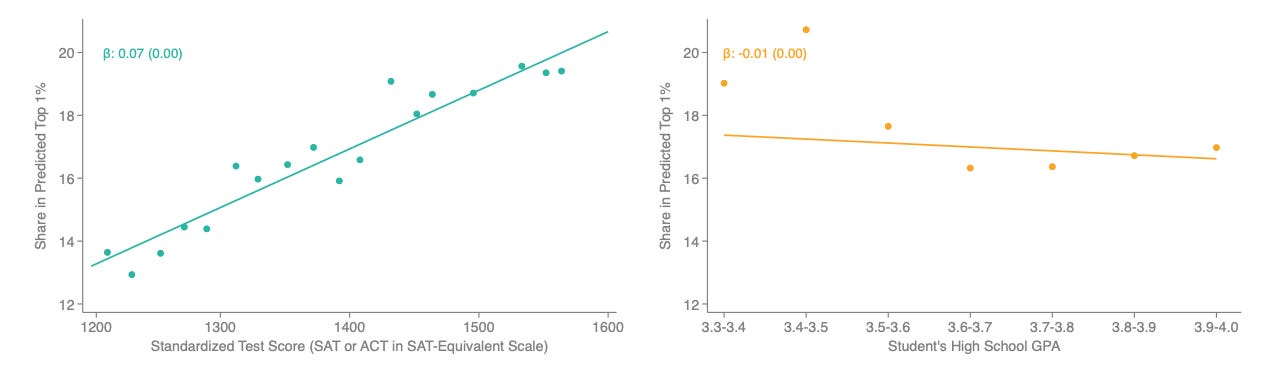
This data indicates that standardized tests constitute an efficient probe that allows us to detect academically promising students from all walks of life and direct them towards a successful career.
In the case of the underserved groups, SAT/ACTs often constitute the only instrument of social mobility. A different study, the 2020 "Academic Council’s Standardized Testing Task Force" report commissioned by the University of California, highlights the following figures:
The Task Force found that of the 22,613 students guaranteed admission [in 2019] through the statewide index (the admissions pathway in which test scores can compensate for lower HSGPA) but not through Eligibility in the Local Context (ELC), which only considers high school grades, about 25% were members of underrepresented minority groups, and 47% were low-income or first generation students. These students would not have been guaranteed admission on the basis of their grades alone.
In other words, if in 2019, University of California had stopped using the SAT/ACT scores in admission decisions, approximately 11,000 highly qualified low-income/first-generation children would have been denied a path towards better economic conditions.
A third article, "ACT/SAT for all: A cheap, effective way to narrow income gaps in college", by Susan M. Dynarski from Brooklings Institute, argues that often, talent remains un-discovered because to be tested one has to "have internet access, a computer, a credit card, and a car. If you are missing any of these resources, [taking a test is] a lot more challenging." One of the extensive studies reviewed there analyses the effects of a free, in-school SAT testing in Michigan. According to that report, affordable testing can increase the number of discovered talented low-income students by 50%:
For every 100 poor students taking a college entrance exam and scoring at a college-ready level, there are nearly 50 poor students who would score college-ready, but do not take the exam.
The total number (all incomes) of the "missing talents" (the study calls them "college-ready [test] non-takers") over the 2003-08 time period is 26,717.
And here is the question. With the legacy and athlete preferences legally challenged, non-academic credentials potentially downweighted as an "affirmative action for the rich", and high school GPA proven to be unreliable, what accelerators of social mobility do we have left? The answer depends on one's definition of social mobility. I would argue that if your goal is to exhaustingly identify and propel to success the segment of the low-income population that is capable of succeeding, the SATs have a potential of becoming your weapon of choice.
-----------
MO is grateful to John N. Friedman for a valuable discussion on the subject of this post.